Ask any pump repair shop what kills the most solar pumps and you will get one answer far more often than any other: running dry. A pump that spins without water loses its cooling, its lubrication and its motor in a matter of minutes — sometimes seconds. The good news is that dry run is also the most preventable failure in the whole system. Almost every modern solar pump controller ships with protection built in; the problem is that most users never wire it up properly, never set the thresholds, and never understand what the alarm is telling them. This guide explains how dry-run protection and controller protection actually work, how to wire them correctly, and how to troubleshoot the alarms that stop a pump in the field. Taizhou Lead Pump Co., Ltd. builds solar pumps from 220 W to 15,000 W — both the pumps and the controllers — so this is written from the factory floor, not from a product brochure.
A submersible pump lives in water for a reason. The water around it does three jobs at once: it cools the motor, it lubricates the bearings and seals, and it carries away heat. When the water level drops and the pump keeps running, all three stop at the same moment. A dry-running motor can reach damaging temperatures in under a minute, and a solar pump — which often runs unattended all day — has no operator standing next to it to hit the switch.
In solar systems there are three common causes of dry run:
· Well drawdown — the pump delivers more than the well can refill, so the water level falls below the intake.
· Low water level — seasonal drought, or a tank/river source that empties faster than expected.
· Loss of prime (surface pumps) — air enters the suction line, the pump spins on air and overheats.
Because a solar pump runs whenever there is sunlight, a dry run can easily last for hours before anyone notices. That is why protection is not optional — it is the single most important accessory in the system.
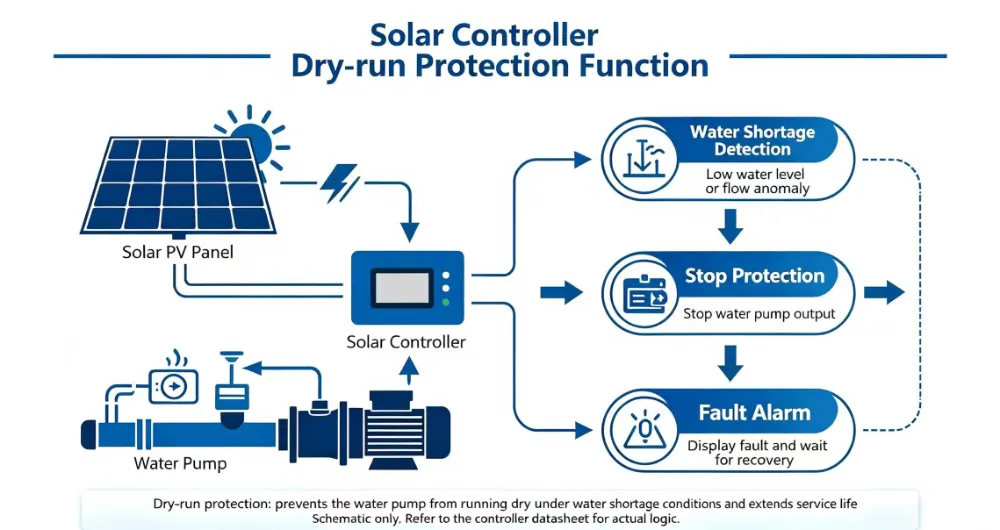
A dry-run event does not need a special sensor to detect. The controller can already 'see' it through the electrical behaviour of the motor. Most Lead Pump controllers use one or more of the following methods:
|
Method |
What it measures |
How it decides the pump is dry |
|
Under-current detection |
Motor current (Amps) |
A dry pump unloads and current drops below a set threshold |
|
Over-current / over-load |
Motor current (Amps) |
Sometimes a dry pump draws more as it overheats; also flags jams |
|
Speed / frequency monitoring |
Motor RPM or drive frequency |
Unusual speed change signals loss of load or cavitation |
|
Power (Watt) threshold |
Instantaneous power |
Power falls below the expected curve for the array |
|
MPPT voltage window |
DC bus voltage |
Voltage collapse or abnormal rise outside the MPPT window |
|
Water level switch |
Float / electrode / probe |
Direct: contacts open when water drops below the probe |
The clever part is the 'auto-restart' logic. When the controller trips on dry run, it does not simply stop and give up. It waits a set interval (commonly 5, 15, 30 or 60 minutes), then tries again. If water has returned, the pump resumes automatically — no manual reset, no wasted trip to the well. If not, it protects the pump and waits again. This cycle repeats until the water is back.
Dry run is only one of the threats a solar pump faces. A well-designed controller stacks several protection layers:
|
Protection |
Protects against |
Typical behaviour |
|
Dry-run / under-current |
Running without water |
Trip + timed auto-restart |
|
Over-current / over-load |
Jams, sand, mechanical lock |
Trip, retry a few times, then lock out |
|
Over-voltage |
High open-circuit panel voltage, surges |
Shut down until voltage normalises |
|
Under-voltage |
Weak sun, dying array, long cable drop |
Pause the pump until voltage recovers |
|
Over-temperature |
Controller or motor overheating |
Derate or stop, resume when cooled |
|
Reverse-polarity |
Wrong PV wiring at installation |
Refuse to start until corrected |
|
MPPT tracking |
Light mismatch, partial shade |
Continuously hunt for max power point |
|
Soft start / ramp |
Water hammer, surge current |
Ramp motor up gradually on every start |
|
Lightning / surge |
Induced spikes on long panel runs |
Surge arrestor + internal MOV clamps |
Electronic dry-run detection reacts after the pump starts to run dry. Water-level control is better: it stops the pump before that happens. There are two common methods, and both are usually wired straight into the controller's level terminals.
A mechanical float rides on the water surface. When the level falls below the set point, the contacts open (or close) and the controller stops the pump. Floats are cheap, rugged and easy to understand. Use one down the well for a low-level cut-out, and one in the tank for a high-level cut-off so the tank cannot overflow.
Two or three stainless probes are lowered to the desired cut-out depth. Water completes a low-voltage circuit between them; when the level drops and the circuit breaks, the pump stops. Probes have no moving parts, so they suit dirty or debris-heavy water where a float could stick.
On Lead Pump controllers the level input is normally low-voltage (safe to touch) and configurable as either 'close to run' or 'open to run' depending on your wiring. Whichever method you use, a hardwired level switch plus the controller's electronic dry-run detection gives you two independent layers of protection — the belt and braces that keep an unattended solar pump alive.
Electronics can only do so much. A large share of 'dry-run' problems are really installation problems at the well itself.
· Set the pump deep enough. The intake should sit well below the lowest expected dynamic water level, with margin for seasonal drawdown.
· Mind the intake clearance. Leave a sensible gap above the well bottom so sand and sediment are not sucked in.
· Match pump to well yield. If the pump is bigger than the well can recharge, it will draw the well down and trip protection all day — size for recovery rate, not just for peak demand.
· Watch the drawdown in summer. A well that copes in the wet season can fall short in the dry season; lower the cut-out probe or set a higher dry-run interval.
· For surface pumps, keep the suction line airtight. Any air leak breaks prime and mimics a dry run.
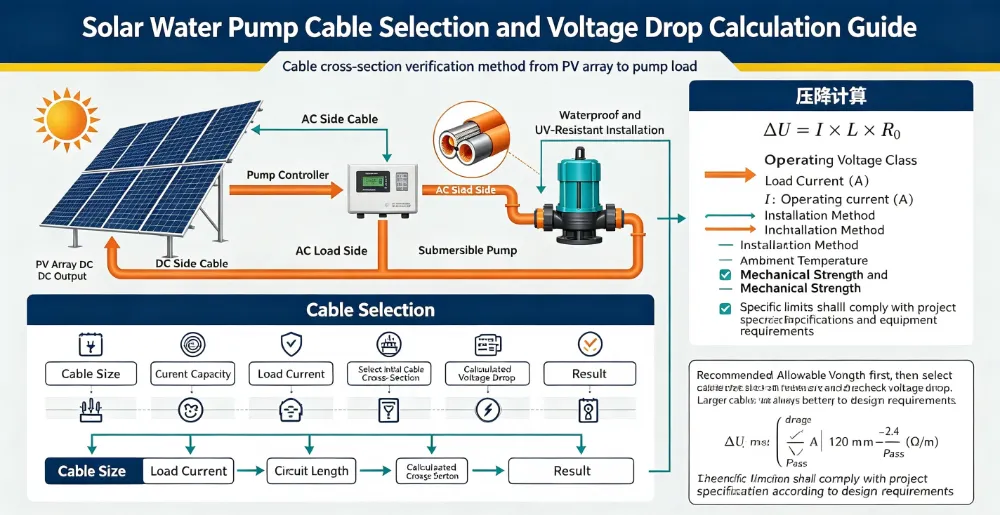
Solar pumps often sit at the end of a long cable run — especially submersible units, where the array is at the surface and the pump is hundreds of metres down the borehole. That distance introduces two problems worth designing for from day one:
· Voltage drop. Thin or over-long cable silently steals voltage; the pump sees less than the array produces and runs slow or on the edge of under-voltage protection. Size the conductor generously and keep runs as short as practical.
· Surge and lightning. Long panel-to-controller runs pick up induced spikes. Fit a surge arrestor at the controller, earth the pump body and the panel frames, and keep the array wiring tidy.
· Correct polarity and tight terminals. Reverse polarity is the most common installation error; check twice before the first power-up and torque every terminal properly.
A dedicated article on cable sizing and voltage-drop calculation for solar pumps is coming; for now, the rule is simple — never undersize the cable to save a little copper, because the loss is paid every sunny hour for the life of the system.
Paradoxically, an over-sized pump is a common reason protection trips constantly. If the pump is much stronger than the well can supply, it pulls the water level down within minutes, the dry-run protection kicks in, the well recovers slowly, and the cycle repeats — the pump spends the afternoon tripping instead of pumping. The fix is not to disable protection (never do that) but to:
· Choose a model whose flow matches the well's realistic recharge rate.
· Use a variable-speed / MPPT drive so the pump slows down instead of stopping when the level drops.
· Set a longer auto-restart interval so the well has time to recover between attempts.
· Add a storage tank and run the pump to fill the tank, rather than trying to match demand directly.
|
Symptom |
Most likely cause |
What to do |
|
Pump never starts, no display |
No array voltage / polarity / fuse |
Check PV voltage at the controller, verify polarity, check fuses |
|
Starts then stops within seconds |
Genuine dry run, or threshold too tight |
Check water level; if wet, loosen the under-current threshold slightly or lengthen restart time |
|
Runs slow, weak flow |
Under-voltage (cable drop, weak sun) |
Shorten/upsize cable, check array, clean panels |
|
Trips on over-current |
Sand, jam, or worn impeller |
Pull and inspect the pump, check for abrasives, clear the intake |
|
Over-temperature stop at midday |
Controller in direct sun, poor airflow |
Shade the controller, improve ventilation, check for over-load |
|
Stops at exactly the same time daily |
Level switch or drawdown point reached |
Lower the probe / adjust the cut-out level, review pump sizing |
|
Frequent restart cycling |
Well too weak for the pump |
Resize the pump or lengthen the restart interval; add storage |
|
No dry-run protection at all |
Feature not wired or disabled |
Connect a level switch and enable dry-run detection — never run unprotected |
Fault codes vary by controller model. Always keep the controller's manual with the installation record, and photograph the wiring before you touch anything. If you are unsure, send the code and a short video to the factory — Lead Pump supports customers in Chinese, English and French.
· Dry-run detection enabled, with a realistic auto-restart interval selected.
· Low-level cut-out probe or float fitted down the well.
· High-level cut-off float fitted in the storage tank.
· Pump set below the lowest seasonal water level, with margin.
· Cable correctly sized for the run; terminals torqued.
· Surge arrestor fitted; pump and panel frames earthed.
· Controller shaded and ventilated.
· Pump flow matched to the well's recovery rate.
· Manual and fault-code list stored near the installation.
· 1. Disabling dry-run protection because it keeps tripping — fix the cause instead, never the protection.
· 2. Buying too large a pump for a weak well, then fighting the resulting trips all season.
· 3. Never fitting a level switch, relying only on electronic detection.
· 4. Setting the cut-out probe too high, so the pump stops while there is still plenty of water.
· 5. Undersizing the cable so under-voltage protection trips in the afternoon.
· 6. Leaving the controller in full sun and blaming the pump for overheating.
· 7. No surge protection on a long, exposed panel run.
· 8. Starting the pump before checking water level after a long dry spell.
A: Technically yes, practically never. A dry run can destroy a motor in minutes, and solar pumps run unattended. Every Lead Pump controller includes dry-run detection — always wire it up and enable it.
A: It stops, waits a set interval (often 5–60 minutes), then restarts automatically to test whether water has returned. If not, it protects the pump again and waits. No manual reset is needed.
A: Ideally, yes. The level switch stops the pump before it runs dry; the electronic detection is a back-up for when the level drops faster than expected. Two independent layers are safer than one.
A: Almost always because the pump is larger than the well's recovery rate, so it draws the well down. Resize the pump, slow it with a variable-speed controller, or extend the restart interval — do not disable protection.
A: The fault code or the conditions tell you. Dry run usually happens when the water level is low or after long pumping; under-voltage typically appears in the afternoon or on a long cable run. The troubleshooting table above maps symptoms to causes.
A: Yes. Hybrid pumps keep the same controller protections — dry run, over/under voltage, over-current and over-temperature — and simply switch between solar and mains/generator input.
A: CE, RoHS and ISO 9001:2015 certification, with a 2-year pump body warranty and 1-year controller warranty — faulty units are replaced (FOB China, no questions asked).
A: Yes — 1 to 5 units for testing. Wholesale is 50+ units per model, and OEM starts at 50 units per model with custom branding, packaging and voltage/frequency.
· Sample orders: 1–5 units for testing.
· Wholesale: 50+ units per model.
· OEM: 50 units per model minimum, with customized branding, packaging and voltage/frequency options.
Taizhou Lead Pump Co., Ltd. is based in Taizhou, Zhejiang — China's core pump manufacturing region — with more than ten years of focus on pump R&D and production. Products cover 220 W to 15,000 W, including 3-inch, 4-inch and 6-inch solar submersible deep-well pumps, solar surface pumps, screw pumps, centrifugal pumps, self-priming pumps, sewage pumps, fountain pumps and expansion tanks. All products carry CE, RoHS and ISO 9001:2015 certification.
Lead Pump holds local company accounts in Nigeria, Tanzania, Kenya, South Africa, Ghana and Cameroon, so African dealers can pay in local currency. Technical support is available in Chinese, English and French, with delivery in 15–25 working days.
Website: www.zjleadpump.com
Email: sales01@zjleadpump.com | WhatsApp: +86 195 6006 2010