A solar pump system is usually sold on two numbers: the pump's head and its flow. Then it is installed, and a third number quietly decides whether it ever performs as advertised — the cable. Undersized cable is one of the most common and least diagnosed faults in solar pumping. The array is fine, the pump is fine, the controller is fine, and yet the pump runs slow, trips on under-voltage at midday, or fails to start at all in the early morning. The culprit is often a few volts lost in a long, thin run of wire.
This guide covers the whole subject in practical terms: how voltage drop works, how much is acceptable, which cable size carries which current, how to size a run step by step with worked examples, and the installation details that decide whether the cable survives ten years in a borehole. It is written by the engineering team at Taizhou Lead Pump Co., Ltd., which builds solar pumps and controllers from 220 W to 15,000 W.
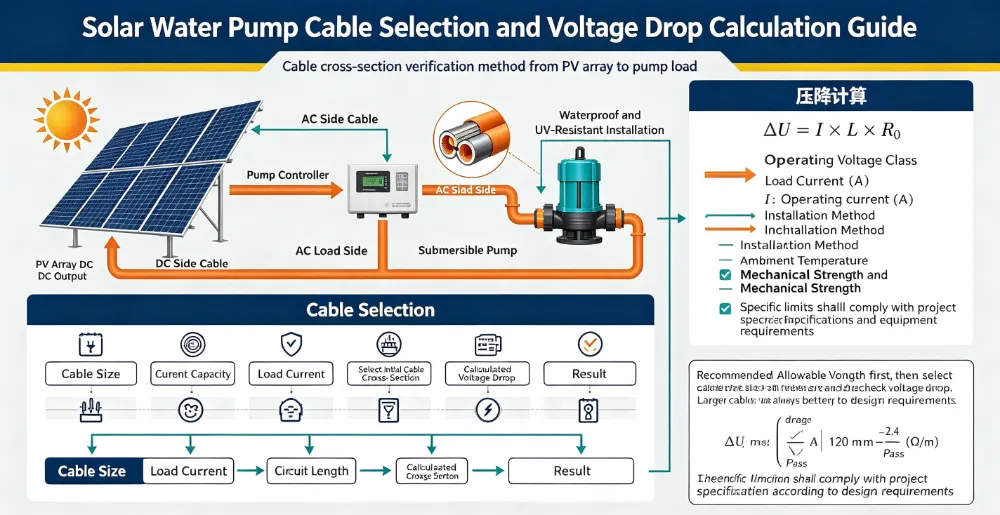
Unlike a mains-powered pump, a solar pump is acutely sensitive to voltage. A grid pump fed at 230 V can tolerate a 10 V drop without anyone noticing. A 96 V DC solar pump that loses 10 V has lost more than 10% of its supply, and the controller's MPPT window, its start-up threshold and its under-voltage protection all begin to misbehave.
There are three separate consequences of getting the cable wrong:
· Lost pumping hours. The pump needs a minimum voltage to start. Voltage drop pushes that threshold later into the morning and earlier in the afternoon, so you lose the most productive edges of the day.
· Lost flow at peak. Motors running below nominal voltage draw more current for the same load, run hotter, and deliver less water — the classic 'it works, but not like the datasheet' complaint.
· Nuisance trips and short life. Under-voltage and over-current protection trip repeatedly; every trip is a start-stop cycle, and every cycle wears the motor, the seals and the controller's capacitors.
Cable selection is always a compromise between two independent limits, and you must satisfy both.
Voltage drop (performance limit)
Every metre of copper has resistance. Current flowing through it loses voltage in proportion to the current, the length and the resistance per metre. Voltage drop does not damage anything by itself, but it starves the motor — this is the limit that decides whether the system performs.
Ampacity — current-carrying capacity (safety limit)
A conductor that carries too much current for its cross-section overheats. In a borehole the cable is bundled with the drop pipe, often inside a shroud, with no airflow — heat cannot escape. Overheating degrades PVC insulation, and degraded insulation in water is how a pump becomes a dead short. This is the limit that decides whether the system is safe.
A cable that passes the voltage-drop test can still fail the ampacity test, and vice versa. Always calculate both, then choose the larger size.
For a two-wire DC circuit — which is what most solar pump arrays and many pump feeds are — the voltage drop is:
VD (V) = 2 × L × I × ρ ÷ A
· L = one-way cable length in metres (the 2 accounts for the return conductor)
· I = current in amps
· ρ = resistivity of copper ≈ 0.0175 Ω·mm²/m at 20 °C (use 0.020 for hot cables and conservative design)
· A = conductor cross-section in mm²
For three-phase AC the same idea becomes VD = √3 × L × I × ρ ÷ A; for single-phase AC use the two-wire formula with the power factor included.
How much drop is acceptable? The industry convention, and the one we design to, is:
|
Circuit section |
Recommended maximum drop |
Why |
|
Array → controller (DC) |
≤ 3% |
Keeps the controller input inside its MPPT window |
|
Controller → pump (DC or AC) |
≤ 3% |
Keeps motor voltage near nominal, protects start-up |
|
Total system |
≤ 5% |
Beyond this, flow and reliability fall away quickly |
|
Any single run over 100 m |
≤ 3%, and check ampacity twice |
Long runs are where all the losses live |
Two practical rules follow. First, always calculate on the highest current the cable will ever see — usually the pump's maximum input current at full load, not its rated running current. Second, add 10–20% margin if the cable will run hot, be bundled with other cables, or sit in direct summer sun.
Metric mm² is the standard in most export markets; North American buyers think in AWG. The approximate equivalents and typical copper ampacity (PVC insulation, 30 °C ambient, single cable in free air) are:
|
mm² |
≈ AWG |
Typical ampacity (A) |
Typical use |
|
1.0 |
18 |
10–12 |
Control and signal wiring only |
|
1.5 |
16 |
14–17 |
Short sensor/float runs, small surface pumps |
|
2.5 |
14 |
19–24 |
Small DC pumps, short drops |
|
4 |
12 |
26–32 |
1–1.5 kW surface and shallow well pumps |
|
6 |
10 |
34–41 |
2.2 kW single-phase, medium runs |
|
10 |
8 |
46–57 |
3–4 kW, longer borehole drops |
|
16 |
6 |
62–76 |
5.5 kW class, deep well feeds |
|
25 |
4 |
80–101 |
7.5–11 kW, long runs |
|
35 |
2 |
95–125 |
15 kW class, main feeders |
Ampacity figures are indicative — always confirm against the cable manufacturer's datasheet for your insulation type and installation method. For submersible drop cable bundled in a borehole, apply a derating factor of roughly 0.8; for cables in conduit or in a hot roof space, 0.7–0.8. When the derated figure is close to your load, go one size up.
The table below gives voltage drop in volts for every 10 m of one-way copper run, two-wire circuit, at 20 °C. It is independent of system voltage, so you can use it for 48 V, 96 V, 220 V or 380 V systems — just compare the result with your allowed percentage.
|
Cable (mm²) |
10 A |
20 A |
30 A |
50 A |
|
1.5 |
2.33 |
4.67 |
7.00 |
11.67 |
|
2.5 |
1.40 |
2.80 |
4.20 |
7.00 |
|
4 |
0.88 |
1.75 |
2.63 |
4.38 |
|
6 |
0.58 |
1.17 |
1.75 |
2.92 |
|
10 |
0.35 |
0.70 |
1.05 |
1.75 |
|
16 |
0.22 |
0.44 |
0.66 |
1.09 |
|
25 |
0.14 |
0.28 |
0.42 |
0.70 |
|
35 |
0.10 |
0.20 |
0.30 |
0.50 |
Read it like this: a 4 mm² cable carrying 20 A loses 1.75 V per 10 m. Over a 60 m one-way run that is 10.5 V — fine on a 380 V system (2.8%), fatal on a 96 V system (10.9%).
Use this sequence for every run, every time:
· Step 1 — Establish the system voltage. Nominal DC bus voltage for DC systems, or phase voltage for AC.
· Step 2 — Find the maximum current. Use the pump's maximum input current at full load from the nameplate or datasheet. For array-to-controller runs, use array short-circuit current × 1.25.
· Step 3 — Measure the real one-way length. Include the vertical drop in the borehole, the horizontal run to the array, and 2–3 m of slack at each end. Do not estimate from a site plan.
· Step 4 — Set the allowed drop. 3% of system voltage for each section, 5% total.
· Step 5 — Solve for A: A = 2 × L × I × ρ ÷ VD_allowed. Round up to the next standard size.
· Step 6 — Check ampacity, apply derating, and check the earth/ground conductor. If in doubt, go one size up — the cost difference is trivial next to a failed pump.
Example A — 1.5 kW DC submersible, 96 V system, 60 m one-way
Maximum pump current 15.6 A. Allowed drop 3% of 96 V = 2.88 V. A = 2 × 60 × 15.6 × 0.0175 ÷ 2.88 = 11.4 mm². Next standard size is 16 mm². Check ampacity: 16 mm² is rated around 62–76 A, derated to about 55 A in a borehole — far above 15.6 A. Result: 16 mm², comfortably inside 3%.
Example B — 2.2 kW AC single-phase surface pump, 220 V, 50 m one-way
Current ≈ 10 A. Allowed drop 3% of 220 V = 6.6 V. A = 2 × 50 × 10 × 0.0175 ÷ 6.6 = 2.65 mm². Next standard size is 4 mm², which gives about 1.75 V drop (0.8%) — a healthy margin for a motor that starts under load. Result: 4 mm².
Example C — 7.5 kW three-phase submersible, 380 V, 120 m one-way
Current ≈ 15 A. Allowed drop 3% of 380 V = 11.4 V. A = 1.732 × 120 × 15 × 0.0175 ÷ 11.4 = 4.8 mm². Voltage drop says 6 mm², but a 15 kW-class borehole installation normally specifies 10 mm² for mechanical robustness and future re-rating. Result: 10 mm² — the ampacity and practical checks win over the minimum calculation, which is normal on deep wells.
Most installations have two distinct cable runs, and they fail for different reasons.
Array → controller
This run is exposed: on a roof, on a ground mount, across a field. It carries the array's full current at the array's voltage. Priorities are UV-rated insulation, mechanical protection against rodents and strimmers, correct polarity, and a DC isolator at the controller. Use solar cable (H1Z2Z2-K or equivalent) rather than ordinary building wire.
Controller → pump
This run is buried in a borehole, permanently wet, and impossible to replace without pulling the pump. Priorities are a proper submersible drop cable with a continuous watertight jacket, a strong physical support (the cable must hang from a strain relief, never from its own conductors), and heat-aware derating. If you are going to overspend anywhere in the system, overspend here.
On long array runs, another option is to raise the array voltage and step it down at the controller: doubling voltage halves current, and losses fall with the square of current. This is why 96 V and 192 V DC systems are common on deeper wells.
· Use one continuous length. Every joint in a wet borehole is a future failure point. If a joint is unavoidable, use a proper submersible splice kit, not tape.
· Support the cable independently. Cable ties every 2–3 m to the drop pipe, plus a strain-relief grip at the top. The conductors must never carry the cable's weight.
· Leave a service loop. 2–3 m of slack at the wellhead and at the controller saves a re-pull during commissioning.
· Keep the cable off the pump intake. Route it straight up the pipe, taped flat, away from the suction area.
· Respect bend radius. Tight bends crack insulation; follow the manufacturer's minimum radius, typically 6–10× cable diameter.
· Ground and bond properly. Earth the pump body and the controller enclosure per local code; on a floating solar array, bond the frames as well.
· Protect against lightning. Long array runs pick up induced spikes; fit a DC surge arrester at the controller and keep the earth lead short and straight.
· Label both ends. A cable schedule taped inside the controller enclosure saves hours for the next technician.
· Sizing on rated current instead of maximum input current — the cable is marginal exactly when it matters.
· Measuring the well depth and forgetting the horizontal run to the array, which is often longer.
· Using building wire in a borehole because it was on the truck. Ordinary PVC does not survive permanent immersion.
· Choosing aluminium to save money on a 40 m DC run, then wondering why the voltage collapse is worse.
· Ignoring temperature derating. A cable rated 41 A in free air may carry 30 A in a bundled borehole.
· Splicing mid-drop with insulation tape. Water always finds the joint.
· Running the pump cable and the array cable in the same conduit without checking derating for both.
· Leaving the cable hanging from its own conductors, so the copper slowly stretches and the resistance rises.
|
Symptom |
Likely cable cause |
What to do |
|
Pump starts late and stops early |
Voltage drop eating the start-up margin |
Measure voltage at controller and at pump; compare with the table above |
|
Under-voltage alarm at midday |
Undersized array run or bad connection |
Check every terminal for heat and torque; recalculate the run |
|
Flow lower than the curve predicts |
Excessive drop at full load |
Log voltage and current together at peak sun |
|
Cable warm or smell of hot plastic |
Ampacity exceeded or a loose terminal |
Stop the pump, isolate, inspect and resize |
|
Repeated nuisance trips only on hot days |
Temperature derating not applied |
Re-rate the cable for 50–60 °C or go one size up |
|
Controller works, pump does not |
Broken conductor or water in a splice |
Insulation resistance test to earth; inspect the splice |
|
Voltage fine at the array, low at the pump |
Long thin drop cable |
Resize the drop cable; consider a higher system voltage |
|
Random trips after rain |
Water ingress at a joint or gland |
Re-terminate with a proper submersible kit and re-test |
· One-way length measured and recorded, not estimated
· Maximum current taken from the datasheet, with 1.25 factor applied where relevant
· Voltage drop calculated for each section, and total under 5%
· Ampacity checked with temperature and bundling derating
· Cable type rated for the environment (UV for array, submersible for borehole)
· No splices below the water line; any splice uses a submersible kit
· Cable supported every 2–3 m and strain-relieved at the wellhead
· Insulation resistance to earth measured and recorded before first start
· Earth continuity and polarity verified
· Cable schedule and as-built lengths left inside the controller
A: Yes — voltage drop scales with length, so a 10 m run tolerates a much smaller conductor than a 100 m run. But never go below the ampacity requirement, and never below 1.5 mm² for anything carrying motor current.
A: It matters, but less dramatically, because mains voltage is higher and the percentage loss is smaller. The same 3% rule applies, and motor start-up is the case to check.
A: There is no fixed limit; there is a limit on cost. Beyond roughly 150–200 m, the cable needed to hold 3% becomes expensive, and raising the system voltage is usually cheaper than buying copper.
A: Not necessarily. It is common and sensible to use a heavier cable for the deep borehole section and a lighter one above ground, provided each section is calculated separately.
A: In low light the array voltage is already near the start-up threshold; any cable drop pushes it below. Improving the array-to-controller run usually fixes it.
A: For fixed, large-section feeders, yes, with correct lugs and antioxidant compound. For submersible drop cable, no — use copper.
A: Insulation resistance to earth (typically >100 MΩ at 500 V for a new cable), continuity on every core, and a polarity check. Record the readings; they are your baseline for future fault-finding.
A: Yes — above the water line, in a proper IP68 enclosure with strain relief on both sides. Below the water line, use a submersible splice kit or do not do it at all.
Cable is the cheapest part of a solar pump system and the easiest to get wrong. Two calculations — voltage drop against the 3% / 5% rule, and ampacity against the derated table — prevent almost every cable-related failure in the field. Do them before the pump goes down the hole, record the numbers, and the system will still be delivering its rated flow in year ten.
Taizhou Lead Pump Co., Ltd. manufactures solar water pumps and a full range of submersible, centrifugal, jet and sewage pumps from 220 W to 15,000 W. We build both the pump and the controller, so we can size a complete system — including the cable — around your well depth, head, flow and sunlight hours. Products carry CE, RoHS and ISO 9001:2015 certification.
· Website: www.zjleadpump.com
· Email: sales01@zjleadpump.com
· WhatsApp: +86 195 6006 2010
· MOQ: 50 sets per model for OEM; samples 1-5 sets; wholesale 50+ sets per model
· Warranty: 2 years on the pump body, 1 year on the controller — replacement, no questions asked (FOB China)
· Africa: local company accounts in Nigeria, Tanzania, Kenya, South Africa, Ghana and Cameroon; local currency payment available
Need your cable sized for a real project? Send us four numbers — system voltage, pump power, well depth and distance to the controller — and our engineering team will return a sizing table and quotation within 24 hours.