In any solar water pumping or pressure boosting system, the pump gets all the attention — but the expansion tank (pressure tank) is the component that decides whether the system delivers smooth, consistent water pressure or short-cycles its way to an early failure. For dealers, distributors, and OEM buyers, understanding the differences between horizontal, vertical, and liner-type tanks is the difference between selling a product and building a repeat-customer business. This guide breaks down Lead Pump's three expansion tank series — CF (horizontal, replaceable bladder), ET-LH (horizontal, polypropylene liner), and WVT (vertical, high-capacity) — with full specifications, sizing rules, and stocking advice.
An expansion tank is a sealed vessel containing a compressed air cushion separated from the water by a rubber bladder or diaphragm. As the pump fills the tank, the air cushion compresses; when the pump switches off, the compressed air pushes stored water into the pipes. The result: stable pressure, fewer pump starts, and dramatically longer pump life.
Key benefits for end customers:
· Fewer pump start/stop cycles — a typical system with a properly sized tank cuts starts by 60-80%, extending pump and controller life.
· Stable water pressure — no more pulsating shower flow or spitting faucets.
· Water hammer protection — the air cushion absorbs pressure surges in the pipework.
· Emergency water reserve — a small buffer of water remains available even during power cuts (important for off-grid solar systems).
Lead Pump's expansion tank range covers three construction types and capacities from 8L to 500L, so there is a tank for every application from a single household booster set to a multi-story building or irrigation network.
The CF series is the workhorse of the range: a carbon steel shell with a fully replaceable butyl/EPDM bladder, available with working pressures up to 16 bar. The horizontal form factor fits crawl spaces, under sinks, and inside compact booster cabinets — the standard choice for household and light commercial boosting where headroom is limited.
|
Model |
Max Pressure (bar) |
Length (mm) |
Height (mm) |
Connector |
Pre-charge (bar) |
Packing (cbm) |
|
CF-19L |
6/8/10/16 |
395 |
292 |
1" |
1.8-2.0 |
0.0356 |
|
CF-24L |
6/8/10/16 |
460 |
292 |
1" |
1.8-2.0 |
0.0399 |
|
CF-36L |
6/8/10 |
435 |
375 |
1" |
1.8-2.0 |
0.0588 |
|
CF-50L |
6/8/10 |
545 |
375 |
1" |
1.8-2.0 |
0.0752 |
|
CF-60L |
6/8/10/16 |
645 |
408 |
1" |
1.8-2.0 |
0.1082 |
|
CF-80L |
6/8/10/16 |
600 |
470 |
1" |
1.8-2.0 |
0.1325 |
|
CF-100L |
6/8/10/16 |
685 |
470 |
1" |
1.8-2.0 |
0.1524 |
The ET-LH series uses a seamless polypropylene liner as the water chamber, backed by a butyl diaphragm and locked in place by a steel clench ring. Water never touches metal — no rust, no scale, no taste or odor transfer. This makes ET-LH the right answer for drinking water systems, food-grade processing, and medical plumbing loops where water purity matters.
|
Model |
Dia (mm) |
Height (mm) |
Length (mm) |
Connector |
Pre-charge (bar) |
Packing (cbm) |
|
ET-8LH |
200 |
230 |
315 |
1" |
1.8-2.0 |
0.0181 |
|
ET-18LH |
278 |
309 |
367 |
1" |
1.8-2.0 |
0.0380 |
|
ET-24LH |
290 |
321 |
447 |
1" |
1.8-2.0 |
0.0496 |
|
ET-35LH |
318 |
353 |
478 |
1" |
1.8-2.0 |
0.0631 |
|
ET-60LH |
390 |
425 |
530 |
1" |
1.8-2.0 |
0.1005 |
|
ET-80LH |
390 |
425 |
726 |
1" |
1.8-2.0 |
0.1367 |
|
ET-100LH |
430 |
475 |
720 |
1" |
1.8-2.0 |
0.1652 |
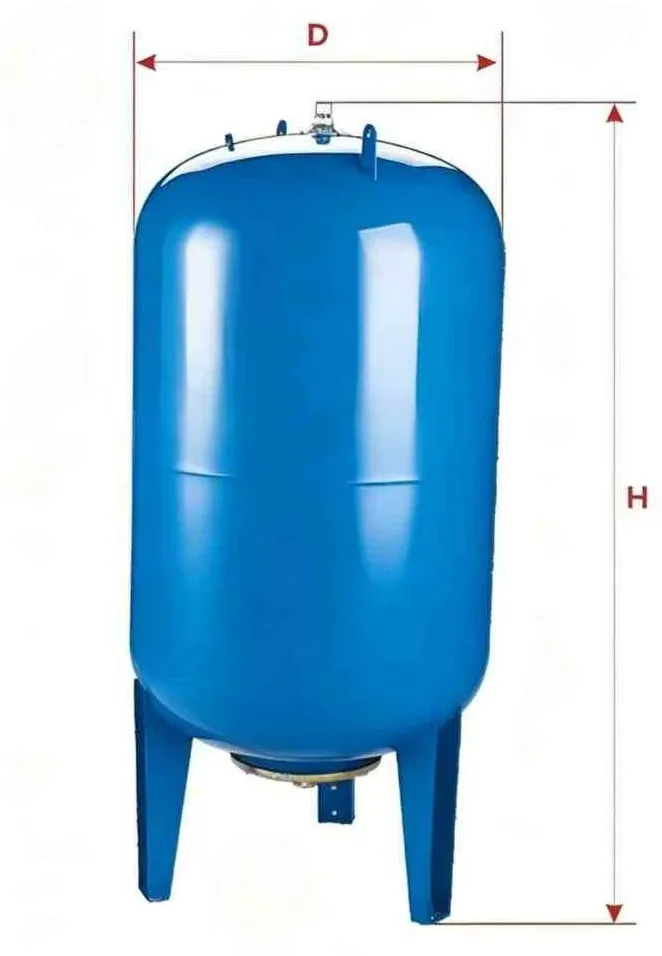
For commercial buildings, apartment blocks, and irrigation networks, the WVT series delivers large-volume vertical tanks from 60L to 500L. Large models accept 10 or 16 bar working pressure with pre-charge options up to 4.0 bar, and the vertical footprint saves floor space in pump rooms.
|
Model |
Max Pressure (bar) |
Diameter (mm) |
Height (mm) |
Connector |
Pre-charge (bar) |
Packing (cbm) |
|
WVT-60L |
6/8/10/16 |
380 |
835 |
1" |
1.8-2.0 |
0.1381 |
|
WVT-80L |
6/8/10/16 |
450 |
785 |
1" |
1.8-2.0 |
0.1600 |
|
WVT-100L |
6/8/10/16 |
450 |
870 |
1" |
1.8-2.0 |
0.1782 |
|
WVT-150L |
10/16 |
500 |
1135 |
1" |
2.5/4.0 |
0.3023 |
|
WVT-200L |
10/16 |
628 |
1080 |
1½" |
2.5/4.0 |
0.4682 |
|
WVT-300L |
10/16 |
628 |
1360 |
1½" |
2.5/4.0 |
0.5831 |
|
WVT-500L |
10/16 |
790 |
1465 |
1½" |
2.5/4.0 |
0.9344 |
Correct sizing is the #1 factor in customer satisfaction. A tank that is too small short-cycles the pump; one that is too large wastes money and floor space. Practical sizing guidance:
· Household booster set (1-2 bathrooms): 18-24L tank per 1-1.5 kW pump.
· Small farm / irrigation (2-5 kW pump): 50-100L tank.
· Multi-story building or commercial system (5.5-15 kW pump): 150-500L tank, or multiple tanks in parallel.
· Rule of thumb: tank volume ≈ 20-30% of the pump's hourly flow rate in liters for pressure-boosting duty.
· Always check the pre-charge: set it 0.2-0.3 bar below the pump cut-in pressure for correct operation.
The internal construction determines the tank's application ceiling. Replaceable bladder tanks (CF) are the most economical and easiest to service — the bladder can be swapped without replacing the whole tank. Diaphragm/liner tanks (ET-LH) isolate water from metal completely, which is why they dominate potable water and food-grade applications. Large vertical tanks (WVT) use heavy-duty butyl diaphragms rated for millions of cycles — built for continuous commercial duty. Butyl rubber is recommended over EPDM for potable water contact; EPDM suits higher-temperature heating loops.
Lead Pump supplies expansion tanks factory-direct with full OEM support: custom branding, custom labeling, and tailored export packaging. Minimum order quantity is 50 units per model — a low-risk entry point for dealers adding tanks to their pump line. All tanks are 100% pressure-tested before shipping, carry CE, RoHS, NSF61 (CF series) and ISO 9001:2015 certifications, and are backed by a 2-year warranty — if a tank fails, we replace it with a new unit FOB China, no questions asked.
Recommended starter inventory for new dealers:
· CF-24L and CF-50L — best sellers for household booster sets.
· ET-24LH — the entry model into potable water projects.
· WVT-100L and WVT-200L — for commercial and irrigation tenders.
· Bundle with solar pump systems: every complete system sold with a tank means fewer warranty claims and happier end users.
A: No. Horizontal and vertical tanks are engineered for their orientation — the internal liner and diaphragm support differ. Always install as labeled, or the bladder may fail prematurely.
A: Pre-charge is the air pressure inside the tank when empty (factory-set at 1.8-2.0 bar, or 2.5/4.0 bar for large WVT models). Working pressure is the maximum system pressure the shell can withstand (up to 16 bar). They are not the same and both must be checked.
A: Every 6-12 months with a simple tire gauge on the Schrader valve. Re-set to 0.2-0.3 bar below the pump cut-in pressure.
A: Yes — especially recommended. Off-grid solar pumps start and stop with changing sunlight; a properly sized tank smooths the cycling and greatly extends the controller's life.
A: Yes. Custom branding, labeling, packaging, and even custom pre-charge settings are available with a 50-unit minimum per model.
Taizhou Lead Pump Co., Ltd. is located in Taizhou, Zhejiang — China's pump manufacturing heartland — with more than a decade of focus on solar water pumps and pressure system accessories. Our product range covers solar pumps from 220W to 15,000W, surface pumps, and the complete CF/ET-LH/WVT expansion tank series, all manufactured in our 20,000 m² facility. Lead Pump holds local company accounts in Nigeria, Tanzania, Kenya, South Africa, Ghana, and Cameroon, so African dealers can pay in local currency. Technical support is available in Chinese, English, and French; delivery takes 15-25 working days.
Website: www.zjleadpump.com
Email: sales01@zjleadpump.com | WhatsApp: +86 195 6006 2010